Text

AI GOVERNANCE AND READINESS FOR PROFESSIONAL FIRMS
Get more value from AI without allowing capability to outrun control
AI use is already spreading through professional firms. Some people are becoming highly capable, but the tools, data and working methods involved are not always visible, consistent or governed.That creates a simple problem: capability can move faster than control.The Practice Labs establishes where your firm stands, what can be evidenced, and the few decisions that matter next.
Where to start
AI Governance Review
In one focused engagement, we assess capability and control, establish your AI Readiness Level, identify up to five material gaps, and give management a practical 90-day direction.£1,950 + VAT. Fixed fee. Completed within ten working days.
Or begin with the free two-minute AI Readiness Check. It gives you an initial indication of where capability and control may be out of step. No email wall and no sales call.
Practical AI governance. Clear evidence. Better decisions.
The gap isn't awareness. It is alignment
Most professional firms already know AI matters. Many have policies, approved tools, pilots and people responsible for adoption.The harder question is whether those activities add up to a coherent position that management can see, govern and evidence.
Visibility
Approved tools tell only part of the story. Firms do not always have a reliable picture of which AI systems people use, what they use them for, or what information enters them.
Consistency
Useful practices often remain personal. The same task may be completed in several different ways, with varying results and no agreed method.
Control
A policy may exist, but data boundaries, exceptions, responsibilities and escalation routes are not always clear at the point where work happens.
Evidence
Leaders may believe AI is being used appropriately without having the evidence needed to demonstrate what is working, what is controlled and what requires attention.
Capability without control creates exposure. Control without capability creates expensive theatre. Readiness requires both.

The AI Readiness Level
A readiness measure that does not average away risk
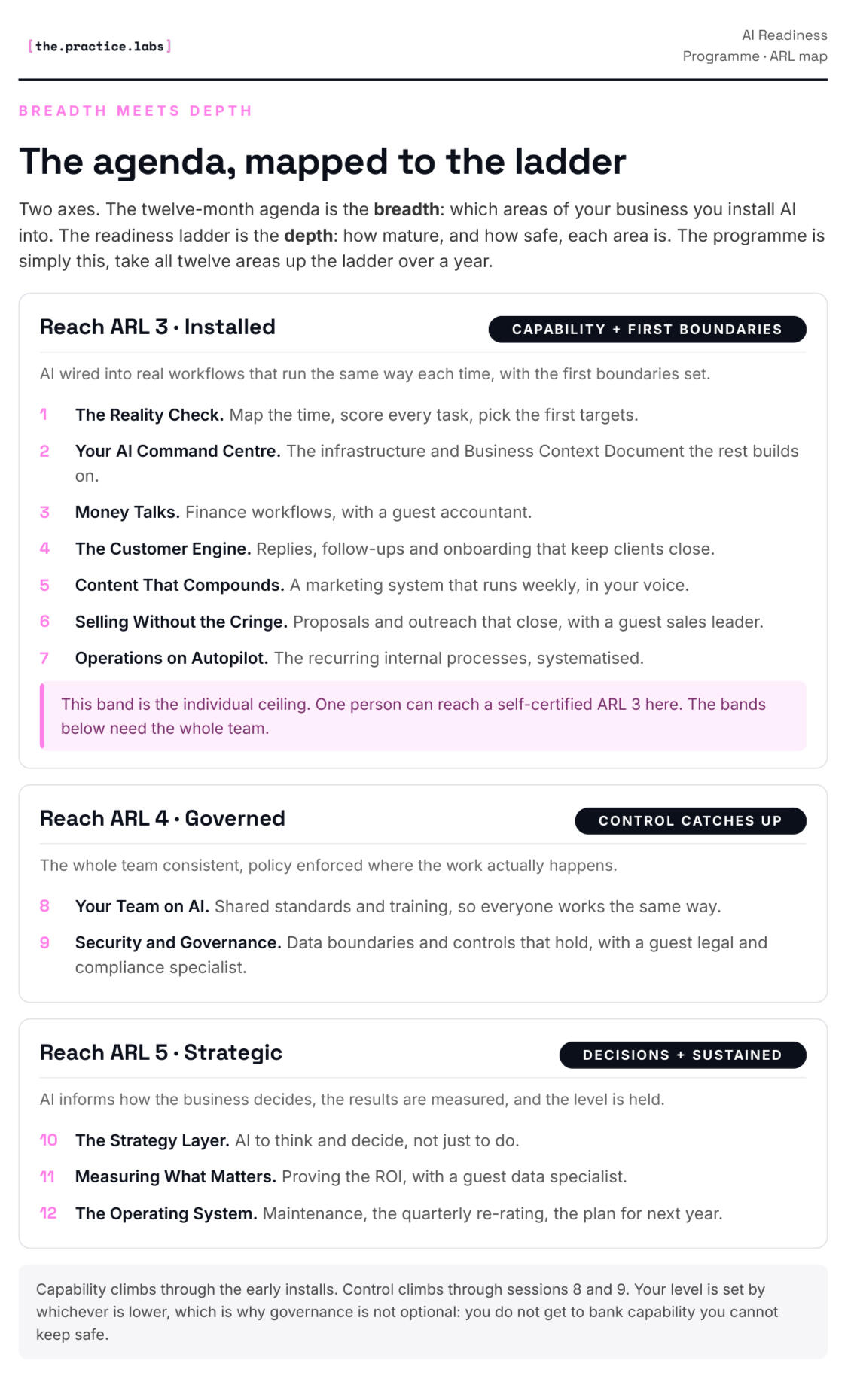
The Practice Labs uses the AI Readiness Level, or ARL: a five-level, evidence-led framework inspired by NASA’s Technology Readiness Levels.It measures two things separately.
Capability
The Practice Labs uses the AI Readiness Level, or ARL: a five-level, evidence-led framework inspired by NASA’s Technology Readiness Levels.It measures two things separately.
Control
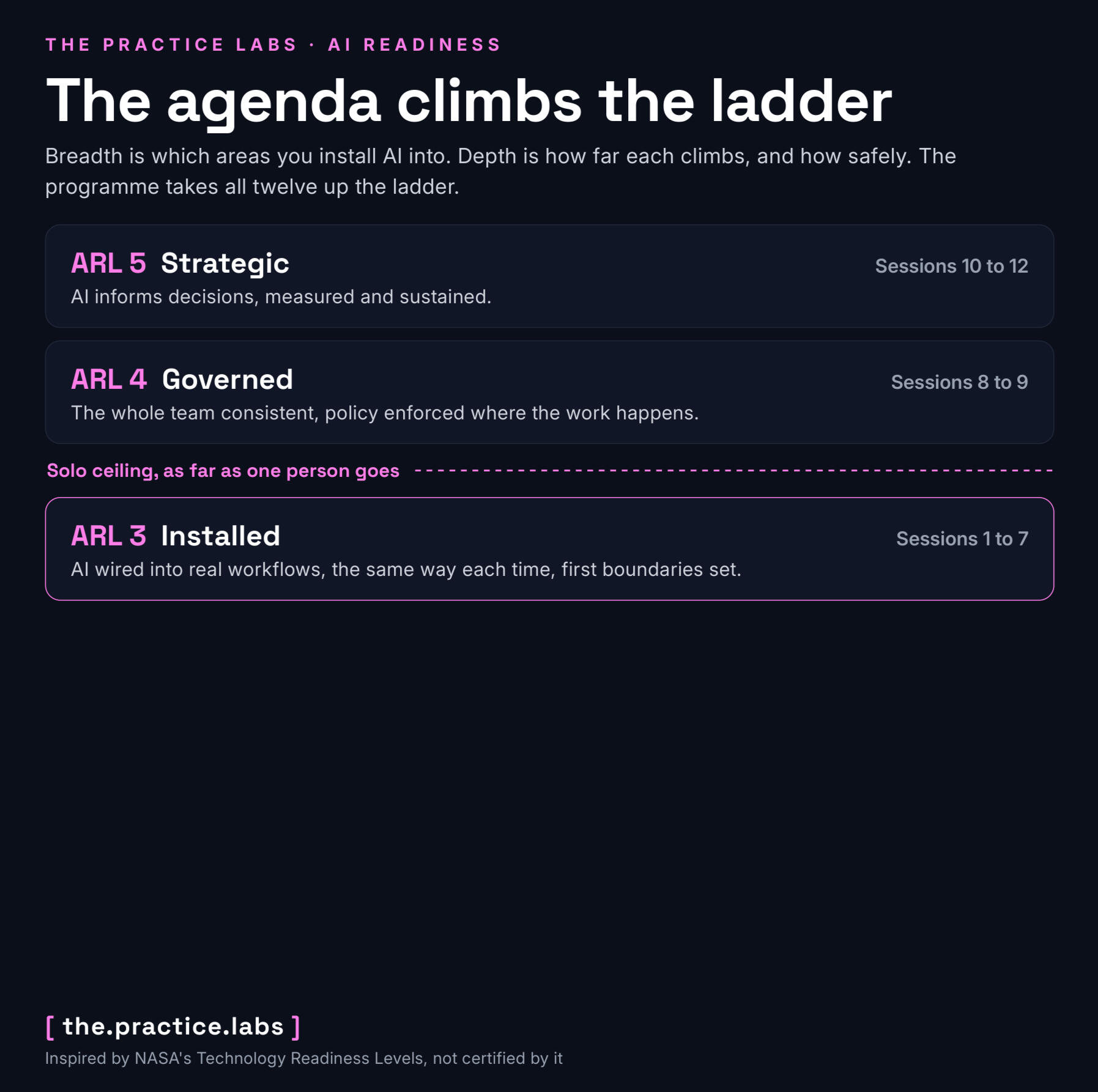
How reliably the firm governs its AI tools, data boundaries, working practices, responsibilities and evidence.We assess both across four operating dimensions:People · Process · Data · TechnologyYour overall ARL is set by the weaker of the two axes.If Capability is Level 4 and Control is Level 2, the firm is not averaged into Level 3. Its AI Readiness Level is 2.That is deliberate. An average can conceal the imbalance management most needs to understand.The score is based on what can be evidenced, not how advanced the firm believes itself to be. The gap between Capability and Control is often the most valuable finding.Inspired by NASA’s Technology Readiness Levels. The Practice Labs is not affiliated with or certified by NASA.

Inspired by NASA’s Technology Readiness Levels. Not affiliated with or certified by NASA.
The AI Governance Review
A clear position. A small number of important decisions.
The AI Governance Review is a focused, independent diagnostic for professional firms that need to understand whether AI capability and control are keeping pace with one another.It answers four practical questions:Where are you now?Your current position across Capability and Control, expressed through an evidence-led AI Readiness Level.Where are the material gaps?The areas where practice, policy and evidence do not yet align.Which gaps matter most?No more than five priorities, separated from the longer list of things that could be improved.What should happen next?The management decisions and practical actions that will make the greatest difference over the next 90 days.What you receive£1,950 + VAT. Fixed fee. Completed within ten working days.The review stands on its own. You may decide to address the findings internally, ask us to help, or conclude that no further work is currently required.
Prefer to start with a quick indication?
Take the free AI Readiness Check
Eight questions and two minutes will give you an initial indication of whether your AI capability and control are moving together.It can help you identify:
Which of the two axes currently appears weaker
Where your working practices may be informal
Which governance questions deserve closer attention
Whether a wider organisational review would be useful
There is no email wall, no required sales call and no obligation to take anything further.
The result is an indicative individual assessment. Establishing an organisational AI Readiness Level requires evidence from across the firm.
See the whole team, not just yourself
The individual assessment gives one person their number. The organisational scan gives you the spread.It is free, and it only starts when the person who can make a decision asks for it. Your team each take the same two-minute read, and each person also says which seat they sit in: leader, manager, or contributor. We aggregate the results into one picture, and we score each function by its floor rather than its average. If three of four operators read a 2, the function is a 2, and a leader's self-scored 3 is recorded as the gap, not averaged away.That gap, sorted by role, is the finding. More often than not it reads the same way: leadership scores the business a level or two above the people actually doing the work. The point of the scan is not to mark anyone's homework. It is intelligence about your own business that you cannot get any other way, and you keep it whether or not we ever work together.

How it works
Five steps, and you can stop at any one of them still better off than you started.The score sets the route. It is not a fixed staircase everyone climbs from the bottom; where your team lands decides which step is the honest next one.
Step 1. Get your number. Two minutes, free. Your own readiness level, and a result you can pass upward.
Step2. Scan the team. Free, once a decision-maker asks. See the spread between the level leadership assumes and the level the team actually runs at.
Step 3. Win the first level. Take one real workflow and turn informal use into evidenced practice. For a team at ARL 1 or 2, that usually means reaching a properly installed ARL 3. For a team already claiming ARL 3, it proves whether the level holds and exposes what is capping it, usually control.
Step 4. Map the whole business.The AI Use Review shows where AI is being used, where client data is exposed, and what should be installed next.
Step 5. Make it stick. The programme installs AI properly, one area at a time, and the quarterly re-rating helps hold the level you reach.

The order is not fixed. A team at ARL 1 or 2 may bank a first level before the full review. A team already governed in parts may go review-first. The free call sets the route.
The AI Use Review
Most firms already have AI in use without anyone setting the rules, so the risk and the opportunity are both hard to see.The AI Use Review makes them visible.It is a focused half-day that turns scattered AI use into a costed plan you can evidence.
Map how AI is actually being used across your team, and on what.
Audit where client and confidential data is flowing into AI tools, and flag the exposures that matter.
Score your readiness, and show the gap between what people believe they are doing and what they can evidence.
Identify the two or three workflows where approved AI gives you the most back, fastest.
You Keep
A written exposure map.
A shortlist of approved, safe use cases to start with.
A costed, sequenced roadmap you can act on, with or without us.
Delivered by Rob, a certified AI Governance Practitioner under LOCS:23. Online by default, or in person for a premium.
Our guarantee: if you finish the review without a clear picture of where you stand and a plan you can act on, we refund it in full. The fee is credited against a 90-day sprint if you go on.

Your first level, in about two weeks
Sometimes the right next step is not a full programme. It is one real workflow, installed properly.The first-level sprint takes one practical use case and turns it into evidenced working practice: a clear workflow, written rules, reusable prompts or templates, and a result your team can repeat.For a team at ARL 1 or 2, that usually means reaching a properly installed ARL 3 in one focused area.
For a team already claiming ARL 3, it tests whether the level holds and shows what is capping progress, usually control.It is priced to the work, and it counts as a wedge against the full programme if you go on.You are not buying a description of your problem. You are banking a level.

What the programme installs
Implementation architecture
What the programme installs
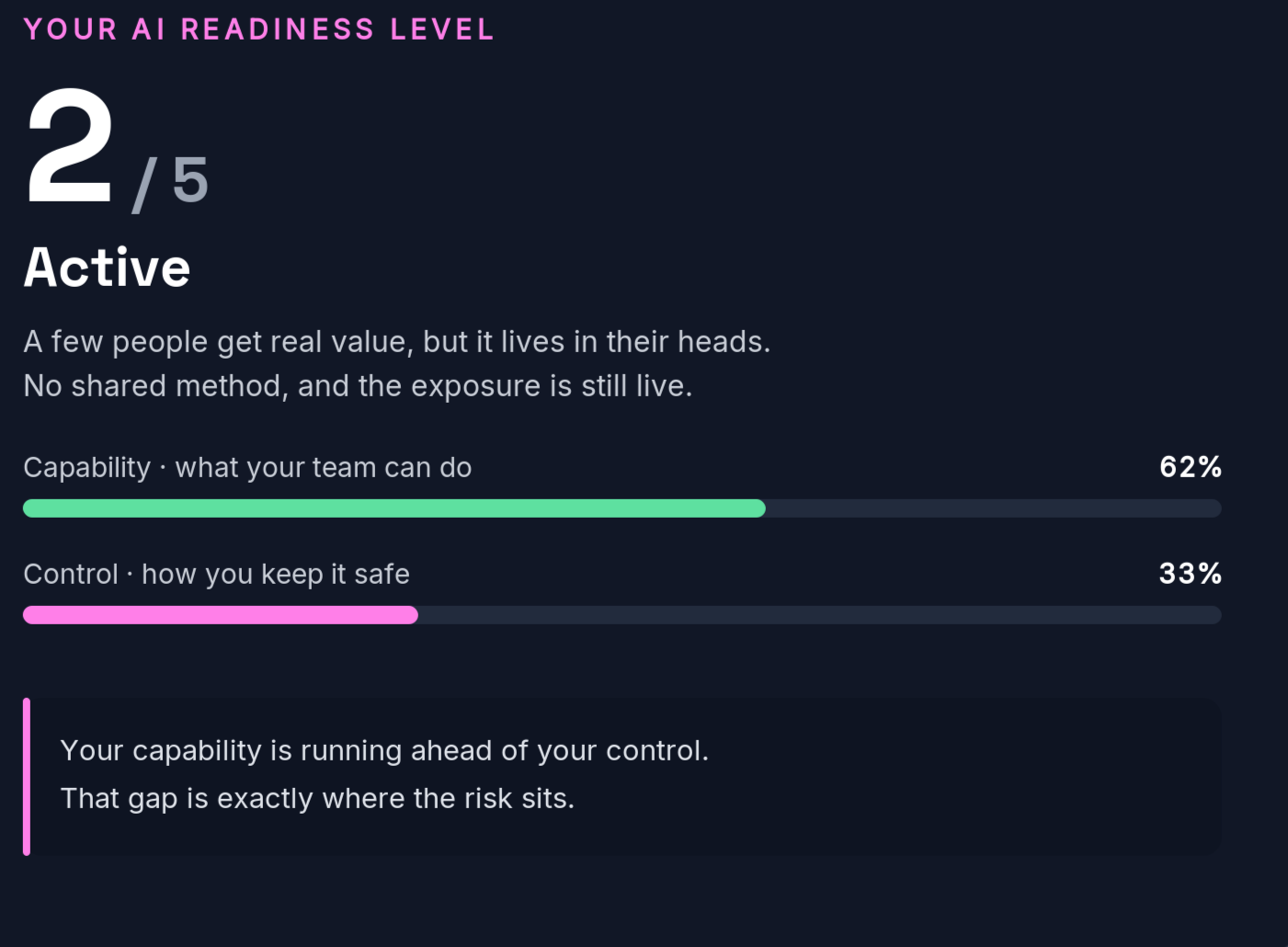
The programme is not a course your team attends and forgets. It is an implementation architecture for getting AI into the business safely, one working area at a time.Each month focuses on a part of the business where AI can save time, improve consistency, reduce risk, or expose a gap that needs control.You leave each stage with something practical installed: a workflow, a rule, a template, a shared method, a decision process, or an evidence point management can rely on.The 12-month agenda gives the work breadth. It covers the areas where AI adoption usually breaks down: business context, finance, client communication, content, sales, operations, team adoption, security, governance, strategy, measurement, and maintenance.The ARL ladder gives the work depth. It shows how far each area has moved from informal use to installed, governed, and strategic practice.Together, they form one map: what to install, how mature it is, and what needs to happen next.
Twelve areas. Five levels. One operating system for safe AI adoption.

What runs every month
Each month gives your team a focused implementation layer: a live session, a written deep-dive, ready-to-deploy templates, and practical work that moves one part of the business up the ladder.
The curriculum installed
Twelve areas of your business over twelve months, from your first real workflow to finance, customer operations, sales, security, governance, measurement, and team-wide adoption.Each one leaves you with something running that was not running before.
The live layer
One monthly group session, run by practitioners who build and govern AI systems for a living. Live demos, real teardowns of your challenges, and direct questions answered.Practitioner access, not a webinar.
The specialists
Four sessions bring in domain specialists who use AI in their field every day: finance, sales, legal and compliance, and measurement.People with scars, not slides.
The governance starter pack
A templated internal AI policy, data boundaries, and controls your business can actually adopt, so the policy lives in the workflows rather than on a wall.This is the part that protects everything else.
Programme scope and price are tailored to your team size and set out in your AI Use Review. There is no standard sticker, because a forty-person firm and a three-hundred-person firm are not the same job.
Who is this for?
This is built for client-sensitive teams that already know AI matters, but need a safer and more consistent way to use it.
You lead a team of roughly 30 to 400 people and can authorise a business decision.
Your people are already using AI, and you want them doing it consistently and safely rather than freelancing.
You handle client, confidential, regulated, or sensitive data.
You want useful workflows, not generic tips.
You would rather bring in someone who governs AI for regulated businesses than someone who only talks about it.
This is not for you if:
You want it all built and run for you. This installs capability in your team; it is not done-for-you outsourcing.
Nobody at your business has touched AI yet. A little baseline use helps, because we move at pace.
You are after generic tips. We deal in specific, governed implementation.
You want a passive course rather than changed working practice.
Proof and the people
Who is behind it
The Practice Labs is led by people who work across AI governance, security, training, and hands-on implementation.
Rob is a certified AI Governance Practitioner under LOCS:23 and works on AI governance and data protection for regulated environments.
Steve brings enterprise training, enablement, commercial delivery, and operational experience across engineering, finance, and telecoms.
Together, they cover the two things most AI work needs and often separates: practical adoption and organisational control.
"Rob and Steve have totally changed the way I think about AI in business. I have come to learn that transformation happens when AI stops being a personal tool and starts becoming your company's operating system."
CEO, regional UK law firm"Would 100% recommend. The value offered here dwarfs the fee."
Mark Rothwell-Brooks, CEO, VerityX

Before you decide.
How does this work with procurement?
The AI Use Review is a simple £2,950 card payment through Stripe, which sits below most procurement thresholds and is easy to expense.
Is our data safe in this process?
That is the whole point of the business. We help you reduce AI data exposure, so we are careful with yours. The discovery looks at where data is flowing, and nothing sensitive needs to leave your control for us to do it. Governance is led by a certified AI Governance Practitioner.
What if we score at Level 1 or 2?
Most teams do, and it is not a failing. The tools arrived faster than anyone could govern them. Knowing your real level is the first useful thing that happens, because you cannot close a gap you have never measured.
We are not very technical, will we keep up?
This is built for business teams, not engineers. If your people can use email and a spreadsheet, they can implement what we cover. The technical depth sits with us.
Do you have to come on-site?
No. Everything runs online by default, which keeps it efficient and affordable. On-site days are available as a premium for teams that want hands-on, in-person delivery.
What does the discovery commit us to?
Nothing. It stands on its own and is useful whether or not you go further. If you do continue to the programme, the discovery has already done the groundwork.
Is there an individual option?
Yes. Start with the free assessment, it takes one person two minutes and gives you your own readiness level. From there, if you want to climb on your own, there is a guided £299 one-off that takes you to a self-certified ARL 3, the individual ceiling, and you finish holding a one-page proof you can show your team. Levels 4 and 5 need the whole team, so when you are ready for that the free review takes you there, and what you paid for the climb is credited against the team engagement. Teams, meanwhile, use that same individual result as the thing they forward to whoever makes the call.
Stop hoping. Start with your number.
Final call to action
Your team is using AI whether you have a plan for it or not.The question is whether anyone can name the level you are operating at, what is exposed, and what it would take to move up safely.Start with your own number. It takes two minutes and costs nothing.If the result belongs upstairs, send it up. The people who can act on it should see it too.If you are ready to map the whole team, book the AI Use Review.
Take the free assessment first
Secured via Stripe. Limited review slots each month
Zeridual Ltd, trading as The Practice Labs © 2026. All rights reserved.